
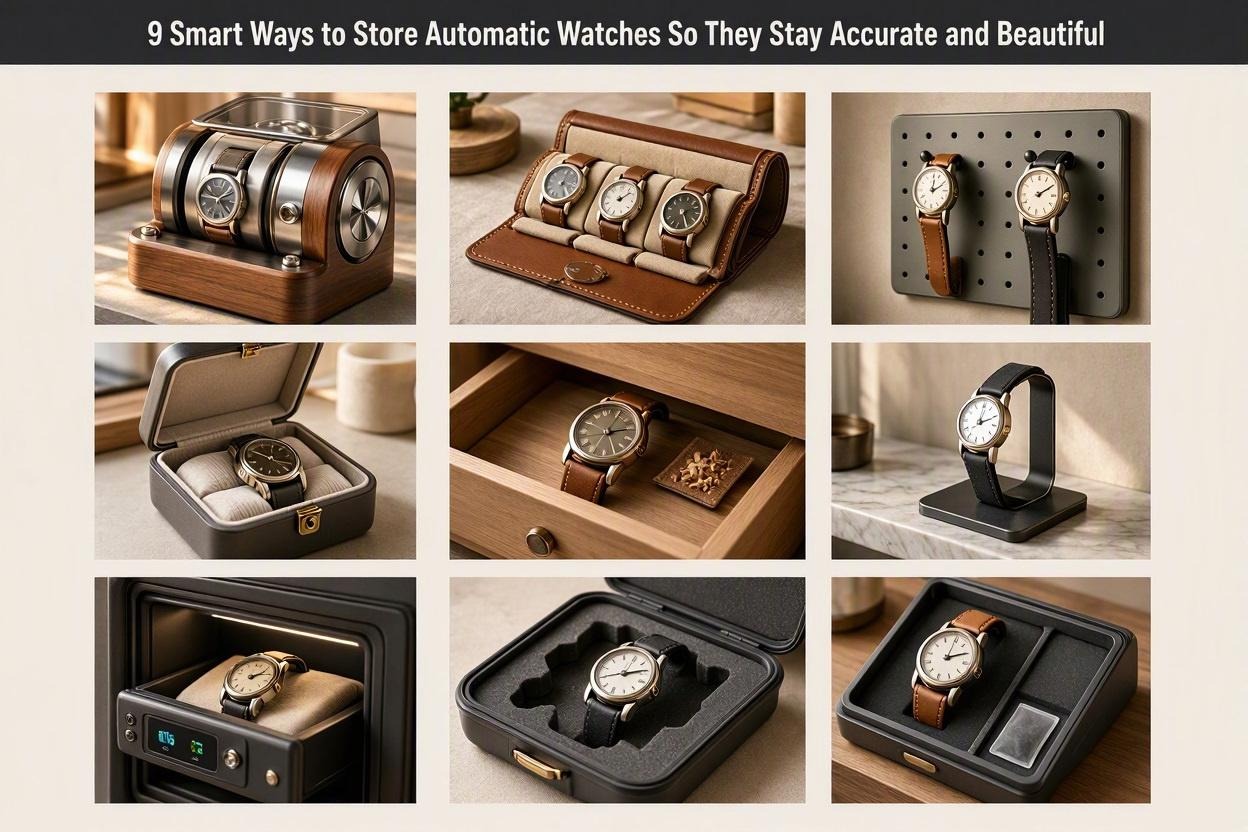
The best way to store an automatic watch is in a padded, individual compartment in a cool, dry room, away from sunlight, moisture, and magnets. If you rotate several watches, a winder keeps the ones you wear least ready to go. If you rarely wear a piece, a quality box and a few good habits protect it for years.
Automatic watches reward good care. A movement holds hundreds of tiny parts, lubricated with oils that age, and every part responds to heat, humidity, and shock. Storage decides whether a watch runs well in ten years or needs a costly repair in three. These nine methods cover what actually matters, from the container to the room to the routine.
1. Start With a Proper Watch Box
A dedicated box does more than look tidy. It shields the case, crystal, and bracelet from knocks, dust, and the daily chaos of a bedside table or drawer.
Look for a soft, non-abrasive lining, a firm lid, and cushioned pillows that hold each watch in place. Avoid boxes that smell strongly of glue or varnish, because those fumes can dull metal finishes over time. A lid with a glass panel also lets you check on your collection without handling it.
Aevitas makes this simple, and you can see more here if you want to compare sizes, capacities, and finishes before you decide.
2. Give Every Watch Its Own Space
Watches that touch each other scratch each other. A bracelet clasp can gouge a neighbouring case in seconds, and a loose crown can chip a crystal.
Keep one watch per compartment, fastened on a cushion with the strap closed loosely. If you own more watches than compartments, wrap the extras in soft microfibre cloth. Never stack them or toss them into a shared pouch.
3. Keep Watches Away From Magnets
Magnetism is one of the most common and least visible causes of an automatic watch running fast. Magnetised hairsprings stick together, which shortens the effective length of the spring and speeds the watch up.
Magnets hide in many everyday objects:
- Smartphones and tablet covers
- Speakers and headphones
- Laptop chargers
- Magnetic handbag clasps and fridge doors
Store your box at least a foot away from these items. If a watch suddenly gains several minutes a day, a watchmaker can demagnetise it in minutes.
4. Control Humidity and Temperature
Moisture attacks a watch from the inside. Damp air can corrode movement parts, cloud the crystal, and rot leather straps. Extreme heat thins lubricants, and cold thickens them.
Aim for a stable room at a comfortable temperature with relative humidity around 40 to 60 percent. Bathrooms, kitchens, garages, and lofts all swing too much. A bedroom wardrobe or study shelf works far better. In damp homes, place a small silica gel pack inside the box, and replace it every few months.
5. Avoid Direct Sunlight
Sunlight fades dials, bleaches leather, and dries out gaskets. A watch left on a sunny windowsill for a summer can show visible dial changes, especially on coloured or vintage pieces.
Choose a shaded spot, or pick a box with a lid you keep closed. If you display your collection, use a cabinet that sits away from windows or one that has UV-filtering glass.
6. Decide Whether to Let Your Watch Stop
Many owners worry that an idle automatic watch will suffer, and the answer depends on how long it sits. A watch that stops for a few days or weeks suffers no harm. You reset the time, wind the crown a few turns, and it runs again.
Long stops carry more risk, because lubricants can slowly settle and thicken inside a motionless movement. The full picture, including what the movement does and what you can do about it, is covered in Aevitas UK What Happens If You Dont wind an automatic watch for months at a time.
The short version: if you plan to store a watch for many months, give it a full manual wind and a short run every few weeks. That keeps the oils moving and lets you spot problems early.
7. Use a Watch Winder for Your Rotation Pieces
A winder rotates your watch gently to mimic the motion of a wrist, which keeps the mainspring charged. It suits watches you wear now and then, and it suits complicated pieces such as perpetual calendars or moon phases, which take time to reset correctly.
A winder does not suit every watch. Simple time-and-date models restart in seconds, so you lose nothing by letting them stop. When you do choose a winder, pick one with adjustable turns per day and a quiet motor, since many movements need only 600 to 900 turns daily. Overwinding does not harm a modern automatic, because a slipping clutch protects the mainspring, but unnecessary rotation still adds wear.
You can browse winders and storage pieces on the Aevitas UK website to match a design to the space you have.
8. Clean and Dry Your Watch Before Storing It
Sweat, skin oils, and salt build up on cases and bracelets. Left in place, they work into crevices and cause staining or corrosion during long storage.
Before you put a watch away, wipe it with a soft, slightly damp cloth, then dry it thoroughly. Clean the bracelet links with a soft brush. For leather straps, use a dry cloth only, since water stiffens and cracks the material. Never store a watch that still carries moisture from a swim or a wash.
9. Check Your Collection Every Few Months
Storage is not a one-time job. Every two to three months, open the box and look at each watch. Check the time, look for condensation, and glance at the straps and gaskets. Wind and reset any watch that has stopped.
This habit also helps you plan servicing. Many manufacturers recommend a service every five to ten years, and an unworn watch still ages internally. If you understand how self-winding movements work, you can see why regular movement makes such a difference, and why a scheduled service beats an emergency repair.
Common Storage Mistakes to Avoid
Even careful owners slip up. Watch for these habits:
- Leaving a watch on a bathroom shelf or near a kettle
- Storing several watches loose in one drawer
- Keeping a watch in a leather box that has never dried out
- Ignoring a watch that sits stopped for a year or more
- Placing the box on top of a speaker, fridge, or router
Fix these and you remove most of the risks that shorten a watch’s life.
Final Thoughts
Good storage costs far less than repair. A well-made box, a stable room, a magnet-free shelf, and a quick check every few months protect both the accuracy and the appearance of your watches. Add a winder for the pieces you rotate most, and let simpler watches rest without worry.
Start with one improvement today. Move your watches out of the drawer, give each one its own space, and build the routine from there. Your collection will run better, look better, and hold its value longer.
FAQs
What is the best way to store an automatic watch long term?
Store it in a padded, individual compartment in a cool, dry room away from sunlight and magnets. Clean it first, wind it fully, and check it every few months.
Should I keep my automatic watch on a winder?
Keep a watch on a winder if you wear it often or if it has a complex calendar. Simple watches do not need one, because they reset quickly after stopping.
Is it bad if an automatic watch stops running?
A short stop causes no damage. Stops that last many months allow lubricants to thicken, so wind and run the watch periodically if you plan long storage.
Can I store watches in a drawer?
You can, but only if you use a lined organiser or individual pouches. Loose watches scratch each other, and most drawers offer no protection from moisture.
How often should I wind a stored automatic watch?
Wind it every few weeks. A few turns of the crown, followed by a short run, keeps the movement lubricated and shows you any timekeeping problems.
How do I stop my watch from becoming magnetised?
Keep it away from phones, speakers, tablet covers, and magnetic clasps. If it starts running fast, a watchmaker can demagnetise it quickly and cheaply.
I can also put this in a Word doc or Markdown file if you want to paste it straight into your CMS.